Okurimono - An interview with director Laurence Lévesque
The press kit interview with director Laurence Lévesque was carried out for NOISE FILM & TV ahead of the film's world premiere at Visions du Réel 2024. Image credit: Okurimono, Laurence Lévesque.
What does ‘Okurimono’ mean?
LL: ‘Okurimono’ is a Japanese word that translates as ‘a precious gift’, which in this case we take to mean ‘heritage’ or a gift that we leave behind when we die. We wrote it in Japanese using hiragana, and not kanji, to avoid an implied connection to the material world. By choosing to write it in hiragana, we wanted to accentuate the intangibility of gifts honoring life, which can be found anywhere, in memories or in nature.
How did the idea for the film come about? When did you meet Noriko?
LL: Noriko is part of my partner’s family, so we knew each other long before this film. Noriko’s mother was a hibakusha, a survivor of the Nagasaki atomic bombing, but she never really talked about it with her, and Noriko didn’t ask questions. On the other hand, Noriko’s father survived the Okinawa Battle, and he would talk about it at length and go to various commemoration events, with Noriko joining him. Noriko knew a great deal about her father's story and very little about her mother's story. As life went on and Noriko was nearing the age of her mother's passing, she started to wonder about her story. One day she said something that stuck with me: “I don’t know why I never asked questions.” That resonated with me because I realised I don’t often ask my parents about their pasts.
Noriko was on her personal journey, and I was moved by her wanting to know more about her mother’s story. During a trip to Japan, we were staying at Noriko’s family house, and the first thing she told me was that she was sad that their house wouldn’t be there anymore, that it would be demolished (later, a decision was made to sell the house). That’s when I thought there was a film. And then we met a lot of hibakusha, and I realised that if I were to make this film, it would be about memories from the past but set in the present. I wanted to convey that memories are still present even if we weren’t there when things happened, even if stories weren’t told.
Noriko’s mother passed away over 30 years ago. What prompted Noriko to go back to Japan now?
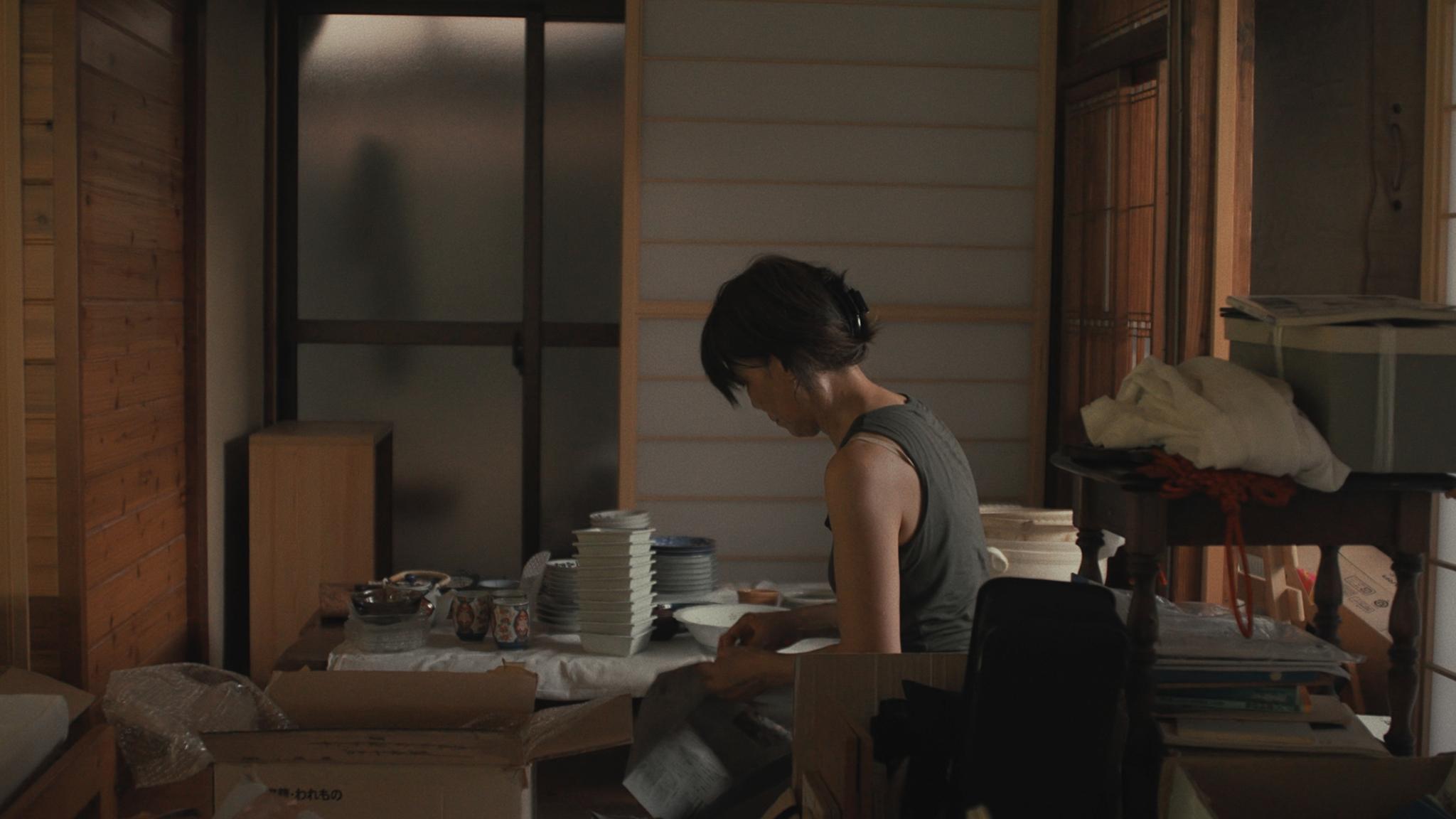
LL: Noriko is very attached to Japan even though she left when she was 18. She settled in Canada long ago and raised her children there, but she would always go back to Japan and stay at her family house. When a decision was made to sell the house, she wanted to go to Japan to take care of every item there to make sure it was treated with respect. And the film’s narrative follows that journey. I didn’t want Okurimono to feel like it was filmed by an outsider — of course, there is a certain North American look to the film because I am North American — but it was important for me to capture the feeling of a woman’s return to her homeland.
As the film addresses the culture of silence and our relationship with memories, I decided not to use archival footage, and instead focus on images of contemporary Japan. The landscapes the film captures represent intimate memories of Noriko's childhood, but they are also bearers of history, timeless witnesses to the horrors of the past. The mountainous landscape itself is crucial to Nagasaki’s history, as these natural elevations helped reduce the spread of damage when the atomic bomb leveled one part of the city.
The term “hibakusha” comes up a few times throughout the film. We learn that the hibakusha and their children endured discrimination for years after the atomic bombing.
LL: Noriko’s mother Mitsuko Tagawa wasn’t the only atomic bomb survivor who didn’t share her story. The survivors were subjected to discrimination and ostracisation, and many didn’t want to speak about their experiences, as they simply wanted to have a sense of normalcy in their lives: get married, have children, get a job, and lead a life worth living. Like many hibakusha, the survivors whose stories we hear in the film had remained silent for a long time. They opened up when they realised how little younger generations knew about this tragedy. Perhaps, as fewer of them are alive, they felt the urgency to tell their stories. If Mitsuko were still alive, she too might have wanted to break the silence. In a way, the hibakusha’s testimonies also echo Mitsuko's story. Through them, Noriko could fill in some gaps of her mother’s story and understand what she had lived through.
What was your rationale for incorporating the discovered letters in the film?
LL: The film is built on several narrative pillars: the house (which in itself has a clear narrative arc), the letters, and the conversations with the hibakusha. At first, I wasn’t sure about including the letters in the film, as I wasn’t such a huge fan of voice-over. We ended up having voice-over because I understood the significance of the letters to the overarching story. The letters are very important to Noriko because they are these physical, tangible fragments of her mother’s memory. But they also add another layer of meaning. The letters were addressed to Mitsuko (she was the addressee) and they give a sense of her presence. They also evidence the beautiful connections she shared with those people. Amid so much loss, she had people in her life, and they were there for each other. At a broader level, the letters are also a testimony to the human condition after the war, which is a little-discussed part of history.
Why did you choose Shima Wada’s letters in particular?
LL: Shima’s letters tell us a story of grief. Shima grieved for her lost son Toshimitsu, and Mitsuko grieved for many of her lost family members. Every hibakusha lost someone in the bombing. In a way, the letters give us access to that collective grief in the aftermath of the Nagasaki bombing. And that grief has a particular trait. Many didn’t know what the atomic bomb was. There was a lack of information about the consequences of radiation sickness. Many couldn’t get the bodies of their loved ones for months on end. So they were locked in that grief, and it was very tangible.
The letters are fascinating because they chronicle the events in the immediate aftermath of the atomic bombing: the first letter was sent in November 1945 and the last one in 1947. The women’s correspondence captures this very condensed period of their lives. One of the letters reveals Shima’s anguish about her son’s final days, as he passed away days after the atomic bombing. So we get a sense of what happened then through the memories that were stored away in those letters, and we can connect the dots.
As in the case of Shima, the letters also help recover elements of other people’s stories. Shima’s grandson didn’t know much about his grandmother’s story, nor did he know that he had an uncle who had died in the atomic bombing. The letters that Noriko handed to him brought some light on his family’s own history.
The sound of cicadas in the film is very pronounced. Could you elaborate on the significance of it?
LL: Some survivors recall cicadas falling silent in the first minutes of the Nagasaki atomic bombing. When we first arrived in Nagasaki for filming, it was August, and cicadas were there in great numbers. I don’t think I had ever heard anything like that before. And then I thought of the survivors’ recollections and the deafening silence that occurs when something really terrible happens. I kept thinking about that when we were filming, in particular during the commemoration scene when the blaring siren went off, drowning out all other sounds, including the screeching of cicadas.
There is also another layer of meaning to it. I didn’t want to use any archives in the film, like the images of the mushroom cloud. So I turned to the sound of cicadas, which each of us knows well, as one of the ways to talk about the past, or more what’s left of the past and what’s still there, and what’s our connection to it. Life goes on, and so does nature. The trees will grow back, and cicadas will resume screeching, but traces of the past will still be there.
Could you talk about the poem ‘When I Was at My Most Beautiful’ by Noriko Ibaragi, which you incorporated in the film?
LL: This beautiful poem acts as another entry into Mitsuko's story. Noriko Ibaragi, who wrote the poem, was the same age as Mitsuko when the atomic bomb flashed above Nagasaki. Like Mitsuko, she was a young girl; they both were just 19. ‘When I Was at My Most Beautiful’ is a very well-known poem in Japan, but when Noriko read it this time, she realised how connected it was to her mother's experience.
What is the significance of the demolishing scene in the film?
LL: What we observe in this scene is the Spirit Boat Procession (Shoronagashi) held for OBon, a Buddhist festival that honors the ancestral spirits. Noriko’s family is Catholic, not Buddhist, but Noriko knew of the festival since she had lived in Nagasaki for many years. Historically, during this festival, people would build boats and pay tribute to the ones who died by releasing the boats into the sea. However, since they could no longer do that for security and logistical reasons, they decided to tear the structures down. In the film, this scene gains a new symbolic meaning, reflecting Noriko’s grief and the act of letting go: of the family house, the painful memories that were never shared, and the stories that have been pieced together. This scene was an emotional one for us because we knew what it meant to Noriko and the film. It also marked the end of shooting for us, and we felt like we too were letting go of the film, having paid tribute to all those who lived and died.
In the final sequence, Noriko says that it’s “an old story but not that old,” “a story from the past but not at the same time.” Could you talk about the relevance of revisiting these stories today?
LL: When we start forgetting, history tends to repeat itself. In North America, we’ve had a military point of view on these tragic events. And I think we need to humanise this history because it affected the real lives of people. The hibakusha, whom we interviewed in the film, were all young when the bombing happened. Some survivors recount their experiences through the eyes of the children that they were during the Nagasaki bombing, like the recollections of a “naked house” that had its roof and walls torn off, or people resembling “ghosts”. Their testimonies are a reminder of the horrid loss of life in the atomic bombing, and the many youths who suffered from it. One of the hibakusha also told us about the path that he took in the hours after the atomic bombing, and it was very similar to Mitsuko’s. We walked along this route, from the University Hospital, close to where the epicenter was, and then up the mountains. It was a sunny day, and we were walking in silence, filming and thinking about all the stories we had heard. The path we walked was eerily serene, but we could sense the memories that had settled in the landscape. I think every place has history, and that’s why it’s crucial to be sensitive to the past.
Have you screened the film to Noriko? What was her response?
LL: When I am filming, I talk about the intentions of the film with the crew and protagonists, starting from the development stage up to editing. So Noriko had a sense of what we were doing. Of course, she didn’t know what would make the cut, but when she saw the film, she said that it was true to her experience, and she recognised herself in it. I felt relieved. As I mentioned earlier, Noriko is part of my partner’s family. My partner Sébastien Blais was the Director of Photography in this film. We were also joined by a friend of ours, Camille Demers-Lambert, who did sound recording. So this film started off with the family ties that were already there, and now — having made this film — we can’t erase it from our relationships; we grew closer.
